

Contents
An apostille is a standardised certificate confirming the authenticity of the signature on a document, the capacity of the person who signed it, and the seal of the issuing body. It was introduced by the Hague Convention of 5 October 1961: a document bearing an apostille is accepted in every member state without consular legalisation. In Ukraine four authorities affix it – the Ministry of Education, the Ministry of Justice, the Ministry of Internal Affairs and the Ministry of Foreign Affairs, all of them in Kyiv.
If a Ukrainian document has to be submitted abroad – for study, a work visa, marriage, a residence permit or an inheritance case – you will almost certainly be asked for an apostille. Below, in plain words: what it does and does not confirm, what it looks like, who issues it in Ukraine, which documents can never be apostilled, and where it is valid. If you would rather not work through it yourself, we arrange apostilles remotely across Ukraine.
What an apostille is, in plain words
An apostille does not make a document "international" and is not a certificate in its own right. It answers a single question the receiving side has: are the signature and the seal on this paper genuine? Article 3 of the Hague Convention puts it precisely – the apostille certifies the authenticity of the signature, the capacity in which the person signing acted and, where appropriate, the identity of the seal or stamp.
What it does not do matters just as much. It does not confirm the content of the document, does not extend its validity, and does not guarantee that a particular institution abroad will accept it – that institution sets its own requirements. An apostille is also not a substitute for translation: in most cases the stamped document still has to be translated into the language of the destination country and the translation certified the way that country requires, by a notary or by a sworn translator. The order matters: when the apostille goes on the original, what you translate is the document together with the stamp.
What an apostille looks like
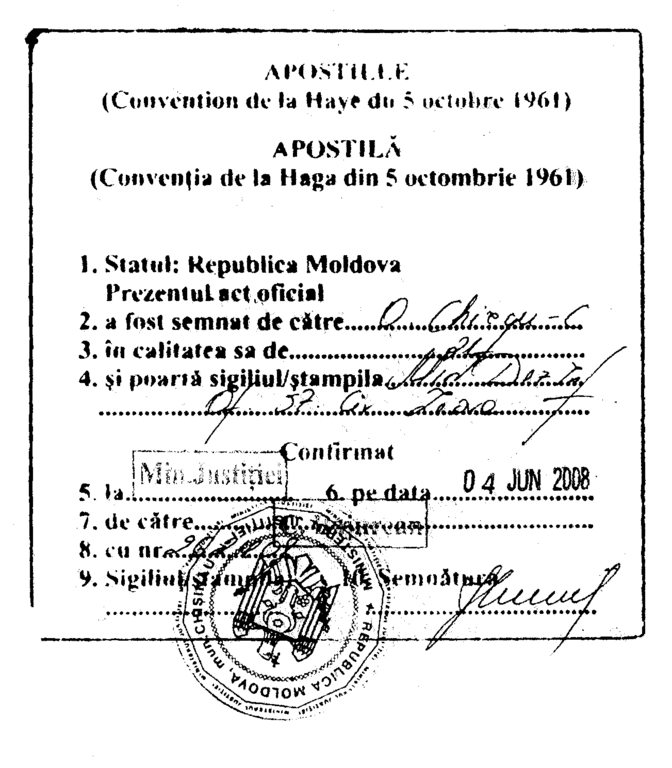
The form is prescribed by the Convention itself, which is why an apostille is recognisable in every country. It is a square with sides at least 9 centimetres long. It is placed either on the document itself or on a separate sheet attached to it – the Convention calls that sheet an "allonge". The heading is always the same and always in French: "Apostille (Convention de La Haye du 5 octobre 1961)", even when the rest is in Ukrainian. Inside there are exactly ten numbered fields:
- Country.
- This public document has been signed by (name).
- Acting in the capacity of (position of the signatory).
- Bears the seal or stamp of (name of the body).
- Certified at (city).
- The date of certification.
- By (the authority affixing the apostille).
- Number.
- Seal or stamp of the authority affixing the apostille.
- Signature of the authorised officer.
It is the number in field eight that an apostille is verified by. Since 1 February 2026 the Ministry of Justice also issues an electronic apostille – an entry in the Electronic Register of Apostilles instead of a stamp on paper, verifiable online by that number.
Who issues apostilles in Ukraine
A common mistake is to write about "three ministries". There are four authorities, each with its own type of document, and all of them are in Kyiv:
- Ministry of Education – educational documents: a diploma and its supplement, a school certificate, academic transcripts. Note that the diploma and the supplement count as two separate documents, so each is processed separately.
- Ministry of Justice – civil-registry documents (birth, marriage, divorce and death certificates), notarised copies and translations, court decisions, archive certificates, powers of attorney and corporate documents.
- Ministry of Internal Affairs – criminal-record certificates. Since 2023 the apostille on those is affixed by the MIA, not by the Ministry of Foreign Affairs as before.
- Ministry of Foreign Affairs – medical documents and everything else outside the first three categories.
Neither the Ministry of Health, nor an administrative service centre, nor a notary affixes an apostille. Administrative service centres issue and reissue documents, including duplicate certificates replacing lost ones; a notary certifies copies, translations and signatures. Only the competent ministry affixes the stamp – and a notarised copy is then apostilled by the Ministry of Justice.
Source: Ministry of Justice apostille register · as of 2026
Which documents are apostilled
An apostille goes on public documents – those issued by a state body, a court, the civil registry or a notary. Most often these are:
- Birth, marriage, divorce and death certificates (Ministry of Justice). Needed for visas, family reunification, marriage abroad and inheritance cases.
- Diplomas, diploma supplements and school certificates (Ministry of Education). Needed for university admission, recognition of qualifications and employment in your field.
- Criminal-record certificates (Ministry of Internal Affairs). Mandatory for a work visa, a residence permit and citizenship.
- Medical certificates (Ministry of Foreign Affairs). Frequently required for study, work and treatment abroad.
- Court decisions, notarised copies and translations, powers of attorney (Ministry of Justice). Used in foreign courts, transactions and representation.
- Archive certificates and corporate documents (Ministry of Justice). Needed to prove length of service, in inheritance cases and to run a business abroad.
Some documents can never be apostilled: laminated originals, plain uncertified photocopies, papers with no official seal or signature, and diplomatic, consular and commercial-customs documents – the Convention's own first article puts those outside its scope. We have covered the full list of exceptions, and what to do in each case, separately.
Where and how to get an apostille
All four authorities are in Kyiv, but you do not have to travel there: documents are filed remotely, by post or through a provider, and documents in the Ministry of Justice category have, since 1 February 2026, been accepted at any civil-registry office, at a notary, at a state archive and through Diia. Timelines depend on the authority: the Ministry of Justice decides within 3 working days, the Ministry of Education takes about 5 working days and up to 20 if a verification is needed, an MIA extract takes up to 10 working days plus the apostille itself, and the Ministry of Foreign Affairs takes longer, sometimes from 20 working days.
There is no single price for an apostille: each of the four authorities charges its own state fee, and it differs for individuals and companies. We have collected the current 2026 fees by authority in a separate article.
Where an apostille is valid
An apostille is recognised only by parties to the Hague Convention; for Ukraine it has been in force since 22 December 2003. Membership changes: China joined on 7 November 2023 and Canada on 11 January 2024, so consular legalisation is no longer needed for either. There is also a third route: with countries that hold a legal-assistance treaty with Ukraine – Poland, Czechia, Moldova, Bulgaria, Romania, Hungary, the Baltic states, Georgia, Kazakhstan and others – documents are often accepted with no apostille at all, a translation being enough. It is worth checking the current list of countries before you file.
Apostille or consular legalisation
If the destination country is not a party to the Hague Convention – the UAE, Saudi Arabia, Qatar or Vietnam, for instance – an apostille has no effect there. Such a document goes through consular legalisation instead: first the competent authority, then the Ministry of Foreign Affairs, then that country's embassy or consulate. It is slower and more expensive than an apostille, and commercial papers often need certification by the Chamber of Commerce and Industry as well. How consular legalisation works is covered in a separate article.
So an apostille is neither a separate document nor a translation, but a square stamp under the Hague Convention confirming a signature, the signatory's capacity and a seal. In Ukraine four authorities in Kyiv affix it, each for its own type of document, and it works only in countries party to the Convention. If you are unsure which authority is yours, whether your paper can be apostilled at all, or whether a translation alone would do – send us a photo of the document and we will map out the route.
Need to get an apostille?
We'll apostille your documents end-to-end – we'll check the destination country's requirements and handle it without queues or trips to the Ministry of Justice.
Order apostille